

Share This Article
There are places built for admiration, and then there are places built for falling in love, quietly and almost against your will, somewhere between a plate of just-caught fish and the particular slant of late afternoon light on old stone. The Mediterranean has never struggled to produce the first kind. Postcard coastlines and photogenic piazzas are, in a sense, the region’s default setting. What’s rarer, and far more valuable, is a destination that gets under the skin rather than simply looking good in a photograph. This summer, three places do exactly that, each in its own register: the sun-bleached warmth of Puglia in southern Italy, the layered beauty of Mallorca in Spain’s Balearic Islands, and the pastel elegance of Menton on the French Riviera’s quieter eastern edge. None of them ask to be rushed. All three reward the traveler willing to slow down enough to actually notice them.
Puglia: Italy’s Sun-Baked Heel

Puglia occupies the heel of Italy’s boot, a region that spent decades overshadowed by Tuscany and the Amalfi Coast before finally, and deservedly, coming into its own. What makes Puglia distinct isn’t a single postcard moment but an entire atmosphere: whitewashed towns built low against the horizon, silvery olive groves stretching for miles, a coastline that alternates between dramatic limestone cliffs and soft white sand, and a culture that treats a long, unhurried lunch as something closer to a civic duty than a luxury.
The region’s most photographed town, Alberobello, is famous for its trulli, conical stone huts with whitewashed walls that look almost fantastical, like something out of a folk tale rather than actual functioning homes. Wandering through the Trulli district in the early morning, before the tour buses arrive, offers a glimpse of a built environment that feels genuinely unlike anywhere else in Europe. But Puglia’s real charm often lives just outside the famous stops, in towns like Locorotondo and Ostuni, the latter known as the “White City” for the lime-washed buildings that seem to glow at dusk. Ostuni’s old town, a maze of narrow alleys climbing a hillside, rewards aimless wandering more than any guided itinerary could.
Along the coast, the Salento peninsula at Puglia’s southern tip offers some of the clearest water in the Mediterranean, with beach towns like Polignano a Mare perched dramatically on cliffs above coves so blue they look digitally enhanced even in person. Polignano’s old town, a tangle of whitewashed streets opening suddenly onto sea views, has become something of an unofficial symbol for the region’s appeal: understated, sun-drenched, and entirely unconcerned with being anything other than itself.
No visit to Puglia is complete without surrendering fully to its food culture, which leans rustic and ingredient-driven rather than elaborate. Orecchiette, the region’s signature ear-shaped pasta, is traditionally served with cime di rapa, a slightly bitter local green, and the combination captures something essential about Puglian cooking: simple, seasonal, and confident enough not to need embellishment. Burrata, the impossibly creamy cousin of mozzarella, is said to have originated in Puglia and tastes noticeably different here, fresher and richer than anywhere it travels to. Evenings often center around long tables at family-run trattorias, where a meal can stretch for hours without anyone checking a watch, accompanied by local wines like Primitivo and Negroamaro that rarely get the international attention they deserve.
Puglia in summer runs warm, often into the mid-nineties Fahrenheit during July and August, and the crowds have grown considerably in recent years as word has spread. Late June or early September offers a gentler version of the same magic: warm enough for the sea, cooler in the evenings, and noticeably quieter in the towns that have started to strain under peak-season popularity.
Mallorca: More Than a Party Island’s Reputation
Mallorca carries a reputation problem that has little to do with most of what the island actually offers. For years, the name conjured images of package-holiday resorts and rowdy nightlife strips, an association that, while not entirely fabricated, obscures an island of genuine, varied beauty that has quietly become one of the Mediterranean’s most compelling summer destinations for travelers seeking something more than a strip of bars.
The island’s interior and northern coast reveal a Mallorca that feels almost unrelated to its party-island caricature. The Serra de Tramuntana, a UNESCO-listed mountain range running along the northwest coast, offers dramatic terraced landscapes, centuries-old stone villages, and hiking trails that wind through olive and almond groves with the sea glinting far below. The village of Deià, tucked into these mountains, has attracted artists and writers for generations, drawn by golden-hour light against dramatic cliffs and a pace of life that seems to have resisted the passage of time almost entirely. A short drive away, Sóller and its Art Nouveau architecture, reachable by a wooden vintage train that winds through the mountains, offers one of the island’s most charming half-day excursions.
Palma, the island’s capital, has undergone something of a renaissance in recent years, developing a genuinely sophisticated food and design scene without losing its historic character. The Gothic spires of Palma Cathedral rise dramatically above the harbor, and the old town’s narrow streets are increasingly filled with small, thoughtfully run restaurants and boutique galleries rather than the tourist-trap souvenir shops of years past. A stroll through the Santa Catalina neighborhood in the early evening, when locals gather at wine bars and the produce market winds down for the day, offers a version of Palma that feels lived-in rather than staged for visitors.
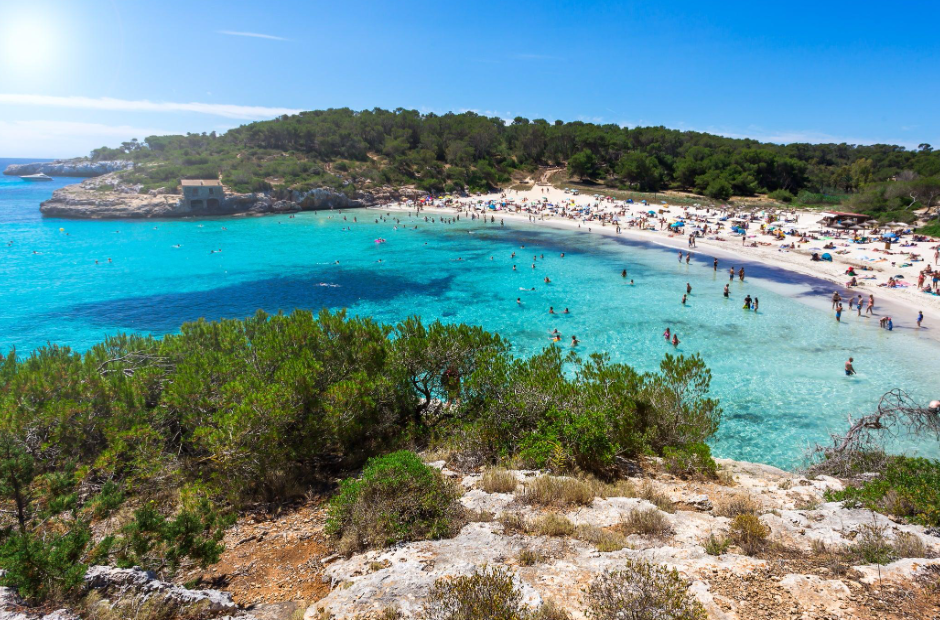
For those seeking the beaches Mallorca is famous for, the island’s variety is considerable. The southeastern coast offers coves, known locally as calas, with turquoise water framed by pine-covered limestone cliffs, quieter and more dramatic than the island’s built-up resort beaches further south. Cala Mondragó and Cala Varques remain relatively unspoiled, requiring a short walk or hike to reach, which naturally filters out much of the crowd drawn to more accessible spots.
Mallorcan cuisine draws on the island’s agricultural heritage, with dishes like tumbet, a layered vegetable dish similar to ratatouille, and pa amb oli, simple bread rubbed with tomato and olive oil, reflecting a food culture built on quality ingredients rather than elaborate technique. Sobrasada, a spreadable cured sausage seasoned with paprika, appears on menus across the island and pairs surprisingly well with the crisp local white wines produced in the Binissalem region, an area still relatively unknown outside Spain despite producing genuinely excellent bottles.
Summer temperatures on Mallorca are moderated somewhat by sea breezes, making it slightly more comfortable than mainland destinations at similar latitudes, though July and August still bring significant crowds, particularly around the more famous beaches and resort areas. June and September offer a compelling alternative, with warm, swimmable water and noticeably thinner crowds outside the peak weeks.
Menton: The Riviera’s Overlooked Jewel
If the French Riviera conjures images of Nice’s promenade or the glamour of Cannes and Saint-Tropez, Menton represents something quieter and, for many who discover it, more affecting. Tucked against the Italian border at the Riviera’s easternmost edge, Menton has long been overshadowed by its more famous neighbors, but it offers a version of the Côte d’Azur that feels more intimate, less performative, and considerably less expensive than the destinations that dominate the region’s reputation.
The town’s most immediately striking feature is its microclimate, sheltered by surrounding mountains in a way that makes it noticeably warmer than the rest of the Riviera, a quality that earned it the nickname “the Pearl of France” and made it a favored winter retreat for European aristocracy in the nineteenth century. That same climate now supports lush gardens throughout the town, most famously the Serre de la Madone and the Jardin Botanique Val Rahmeh, subtropical gardens filled with palms, citrus trees, and exotic plants that thrive in conditions unusual for this latitude.
Menton’s old town spills down a hillside toward the sea in a cascade of pastel-colored buildings, ochre, apricot, and faded pink, that give the town a softer visual character than the whiter, more austere architecture found elsewhere along the coast. Climbing the steps of the old town toward the Basilique Saint-Michel Archange, a baroque church perched at the hill’s summit, rewards visitors with panoramic views over terracotta rooftops toward the Mediterranean, a vista that captures Menton’s particular blend of faded grandeur and genuine warmth.
Lemons are something close to a civic obsession here; Menton is famous throughout France for the quality of its citrus, celebrated each winter with a dedicated lemon festival, and the fruit appears throughout the local cuisine in ways that go well beyond garnish. Restaurants along the old port serve socca, a chickpea flatbread borrowed from nearby Nice, alongside fresh seafood and pissaladière, a savory onion tart topped with anchovies and olives that reflects the region’s blended French-Italian culinary identity. The town’s markets, particularly the covered Marché Couvert near the old port, offer an easy, unpretentious way to sample the local produce and cured meats without the formality, or expense, of a full restaurant meal.
Menton’s beaches lean pebbled rather than sandy, in keeping with much of this stretch of coastline, but the clarity of the water and the relative quiet compared to Nice or Monaco, just a short drive away, make it an appealing base for those who want Riviera glamour without Riviera crowds or Riviera prices. A short trip along the coast to Monaco offers a striking contrast for a day, all polish and spectacle, before returning to Menton’s gentler, more human scale in the evening.
Summer in Menton runs warm but rarely oppressive, tempered by the same sheltered microclimate that made the town famous in the first place. Because it remains lesser-known than its glitzier neighbors, even peak summer months feel comparatively unhurried, particularly in the old town’s quieter corners away from the main promenade.
Three Different Kinds of Falling in Love
What unites Puglia, Mallorca, and Menton isn’t geography or cuisine, though all three share a Mediterranean sensibility built around good food, warm light, and unhurried afternoons. It’s the particular quality of being places that don’t announce themselves loudly, that reveal their best qualities slowly, to travelers willing to wander a little further than the most obvious stop, linger a little longer at a table, or take a road that isn’t the most direct route to the next destination.
Puglia offers rustic warmth and a coastline still relatively free of overdevelopment. Mallorca offers unexpected range, mountain villages and sophisticated city life alongside the beaches it’s known for. Menton offers a gentler, more intimate version of Riviera glamour, sheltered both by its mountains and by its relative obscurity. Each, in its own way, makes the case that the most memorable summer destinations aren’t always the ones most photographed, but the ones that give a traveler room to actually notice where they are, and, almost without meaning to, fall a little bit in love with it.
